note · evergreen
Recording: what mattered
A fixed scene, one pick slot, boards as in a real game, every episode checked, and no waiting at the start.
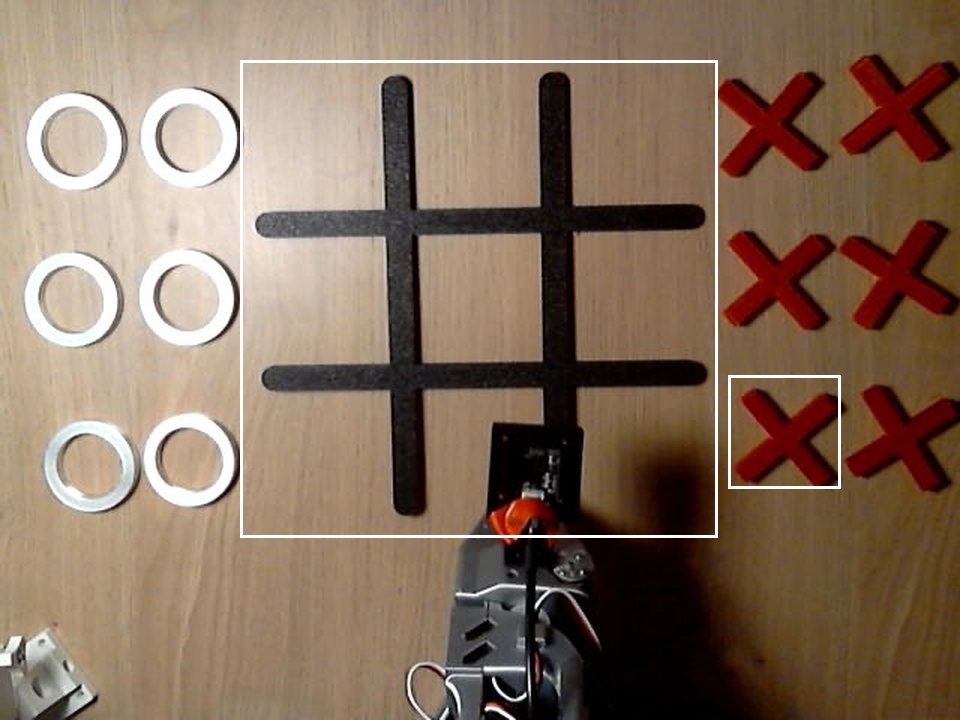
The scene at the start of a game. The small outline is the pick slot; the large one is the area that is cropped and shown to Claude.
I recorded 45 demonstrations, five per cell. Each one is a single move: leave the rest pose, pick the X, put it in the cell, come back. This is what turned out to matter.
- Nothing moves. The grid, the slots, the arm base and the top camera sit on tape marks, and the light stays the same. The model imitates what it saw and is lost in a scene it has not seen.
- One pick slot. The X pieces are identical, so the robot always takes one from the same spot and I refill it. Six slots would make 6 × 9 = 54 situations to record instead of nine.
- Boards as in a real game. If every demonstration starts on an empty board, the arm hits the pieces on a full one. Mine go from empty to all eight other cells filled.
- Check every episode. Right board, right cell, right label, cameras not swapped. One had 22 motionless seconds at the end, so I recorded it again.
- Start moving right away. I waited 2.4 seconds on average before I moved, and the model learned to wait.
The clean set has 45 episodes and 28,707 frames, about 16 minutes. That is little: LeRobot's documentation suggests about 50 episodes for a single task, and here 45 are split over nine. The pilot was only meant to prove the chain.